Client work · Custom theme & plugin
Commerce Pricing Engine
A storefront with pricing rules that can be explained, paused and reviewed.
- Contribution
- Original storefront theme, pricing engine and controlled catalogue migration.
- Engineering focus
- Weight/purity calculations, overrides and retained quote decisions.
- Evidence
- Dated local checks plus a separate hosted no-payment quote journey.
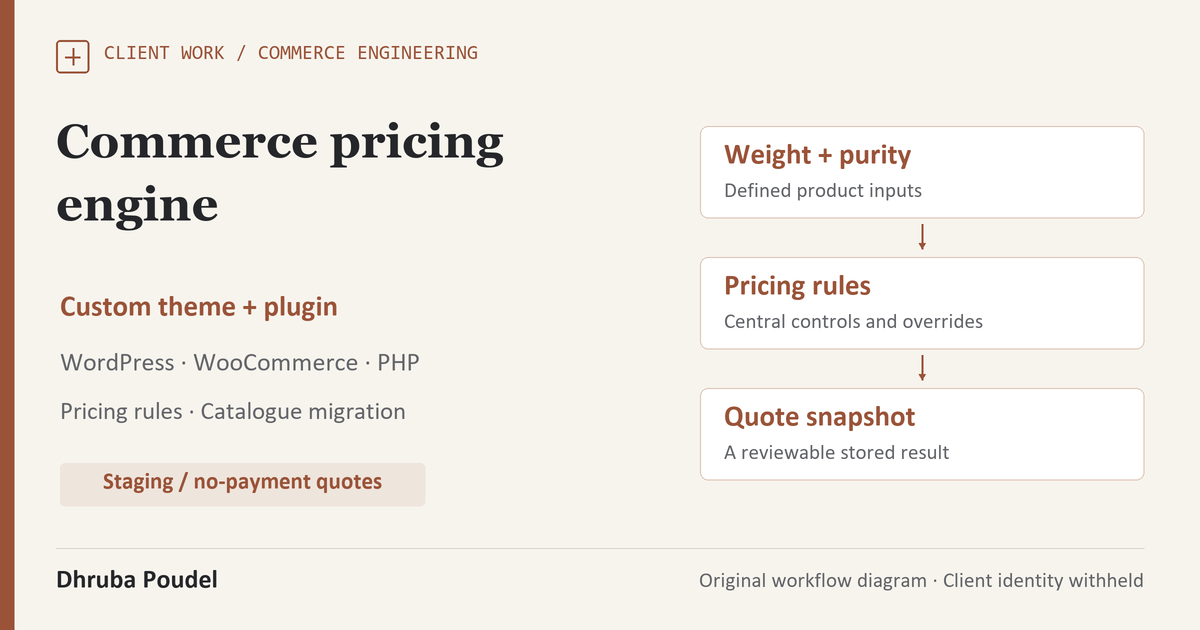
Keep a changing product price explainable.
A jewellery catalogue needs to present a coherent storefront while keeping material weight, purity, charges and pricing overrides consistent. A price shown in the interface should have an explainable calculation and a clear relationship with the later quote.
I designed and developed a native WordPress/WooCommerce theme and a central pricing plugin, then migrated the reviewed catalogue into staging. The client identity, product assets, rates and order references are withheld.
Separate presentation from the pricing decisions.
The custom theme provides the storefront, product and variation interfaces, saved-item experience and editable story controls. The plugin owns the central material rates, weight/purity calculations, category and product overrides, and quote-processing behaviour.
One price rule, several interface surfaces
A central calculation path reduces the chance that a catalogue tile, variation and quote independently interpret a rule. Fixed overrides and percentage adjustments need a predictable precedence, with an explicit paused state when public pricing should be unavailable.
A quote is a controlled decision, not a payment.
The staging workflow supports a no-payment quote journey. It carries the selected item and calculated pricing context into an unpaid administrative record, keeping the quote separate from live payment-provider acceptance.
I also prepared a controlled catalogue import. Product records were created as drafts so imagery, material attributes, stock, policy and tax settings could be reviewed before public release.
- Draft-first migration
- Import content into a reviewable staging state rather than publish it automatically.
- Price availability
- Keep the owner pause explicit; reopening uses the saved inputs and does not fetch a fresh rate.
- Snapshot integrity
- Retain the quote decision so a later change to a central rate does not rewrite what was previously presented.
- External rates
- Automatic rate polling remains off. The existence of connector code is separate from a connected and accepted live feed.
Distinguish local tests from the hosted journey.
- Retained record
- The 20 October 2026 staging-migration record documents the custom theme and plugin installed together.
- Local integration
- 83 real WordPress integration checks were recorded in the retained verification material.
- Isolated checks
- 234 isolated checks were recorded separately. These counts are not combined into a claim about live end-to-end coverage.
- Hosted observation
- The recorded guest quote journey produced an unpaid administrative state with a pricing snapshot; physical stock remained unchanged in that test.
- Restored state
- After the hosted test, the draft catalogue and paused public-pricing state were preserved.
Current delivery stage
Installed staging implementation with a recorded no-payment quote journey. No live payment transaction, active automatic price feed or owner-approved storefront launch is claimed.
A staging result leaves a clear release checklist.
Before launch, the owner needs to approve actual catalogue content, stock and fulfilment rules, tax treatment, shipping, policies, notifications and public pricing availability. The technical acceptance also needs to cover the chosen live payment and notification providers.
This case uses an original generic illustration and a sanitised description. Customer source, identity, catalogue photographs, exact pricing inputs and administrative records remain private.