Own product · Booking & community platform
Purano Maidan
A connected platform for finding a ground, organising a team and running a venue.
- Application scope
- Player, organiser, venue-owner and administrator journeys.
- Engineering focus
- Identity, membership, scheduling and coherent state transitions.
- Evidence
- 97 app checks and a separate 33-check core API suite recorded on 28 August 2026.
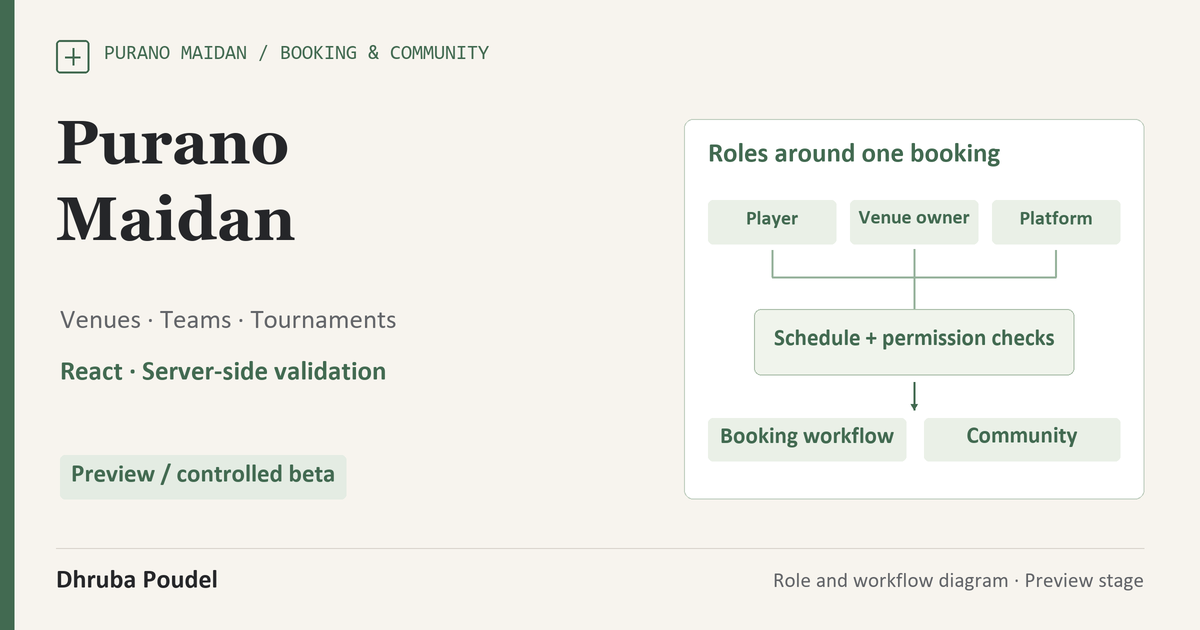
Connect the venue, the booking and the people around a game.
Purano Maidan is my sports booking and community-platform project. It brings venue discovery, customer bookings, venue operations, teams and tournaments into connected but role-specific workspaces.
The core challenge is consistency across those journeys. A player joining a team, an organiser accepting a request and a venue owner reserving a calendar all need a clear identity and an authorised state transition.
Keep ownership and scheduling rules on the service side.
The React application connects role-aware interfaces to backend and data services. Server-side checks handle account ownership and booking consistency, while the interface makes the next action understandable for customers, organisers, venue owners and administrators.
The source includes separate Node/SQLite and managed-edge deployment paths. Those are implementation options; this case does not imply that every path is accepted in production.
Use account identity, not a display name.
The retained workflow review exposed a membership check that compared a player’s display name. I changed the decision to use the authenticated account ID, so two people with the same name do not become the same member.
I also connected public-team discovery and pending requests to role-scoped queries, repaired a tournament-entry modal path, and made confirmed players visible to the organiser through a private squad handoff.
- Availability to squad
- A player announcement can create a temporary pickup squad; claiming a place respects capacity and exposes the confirmed player to the organiser.
- Team membership
- Public requests have explicit accept/decline decisions. Private invitations use a scoped code rather than a name match.
- Tournament lifecycle
- Venue calendar reservation, team/roster submission and owner confirmation form a related state sequence.
- Wrong role
- An already signed-in person receives correct-workspace guidance instead of an unexplained sign-in loop.
Keep the local acceptance result distinct from the live environment.
- Test context
- The 28 August 2026 UAT record covers a local production build with sample data across player, organiser, venue-owner and administrator journeys.
- Application checks
- 97 application checks were recorded as passing after the documented repairs.
- Core API checks
- A separate 33-check core API suite passed. The two totals are not added together without establishing suite overlap.
- Browser review
- That dated review records no console warnings/errors in the covered journeys and a 390-pixel mobile check.
- Current public surface
- A public preview is available. A rendered homepage is separate from fresh end-to-end acceptance of its account, booking and external-provider paths.
Current delivery stage
Preview / controlled beta. Real merchant/payment acceptance, external message delivery and the current hosted end-to-end journey remain separate milestones. Directory records are not customers, active users or signed partners.
Take the change through a controlled release.
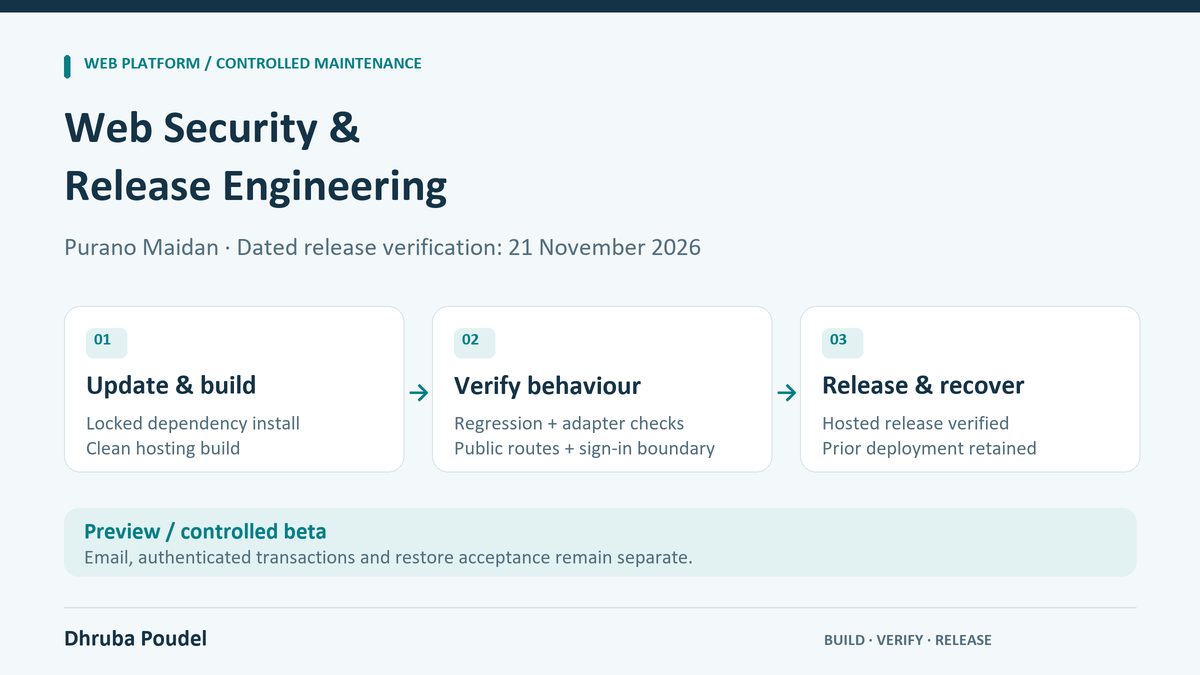
I followed the platform into dependency maintenance and hosted release verification. The 21 November 2026 record confirms a completed/current maintenance deployment after a locked dependency install, a clean build, regression checks and hosting-adapter smoke tests.
- Repeatable build
- A locked dependency installation and clean hosting build completed before deployment.
- Regression checks
- The recorded build and test checks passed, together with hosting-adapter smoke checks.
- Public journeys
- Verified the homepage, help centre, direct venue route and refresh, public directory response and application health response.
- Sign-in boundary
- Exercised sign-in and reset screens and confirmed rejection of unauthenticated administrator requests.
- Rollback option
- Retained the previous successful deployment. Backup restoration was outside this release’s exercised scope.
What the release record establishes
A verified maintenance release within the checks above. The platform remains a public preview/controlled beta; real email delivery, authenticated transactions and backup restoration require separate acceptance.
Verify the deployed journey before accepting real bookings.
The next operational acceptance should repeat an approved synthetic customer-to-owner journey against the selected hosted environment, including a two-browser concurrency check and the resulting durable booking state.
External email, push and payment providers need their own acceptance runs, together with backup/restore ownership and operating guidance. No actual payment, user-growth, customer-adoption or revenue claim is made in this case.